


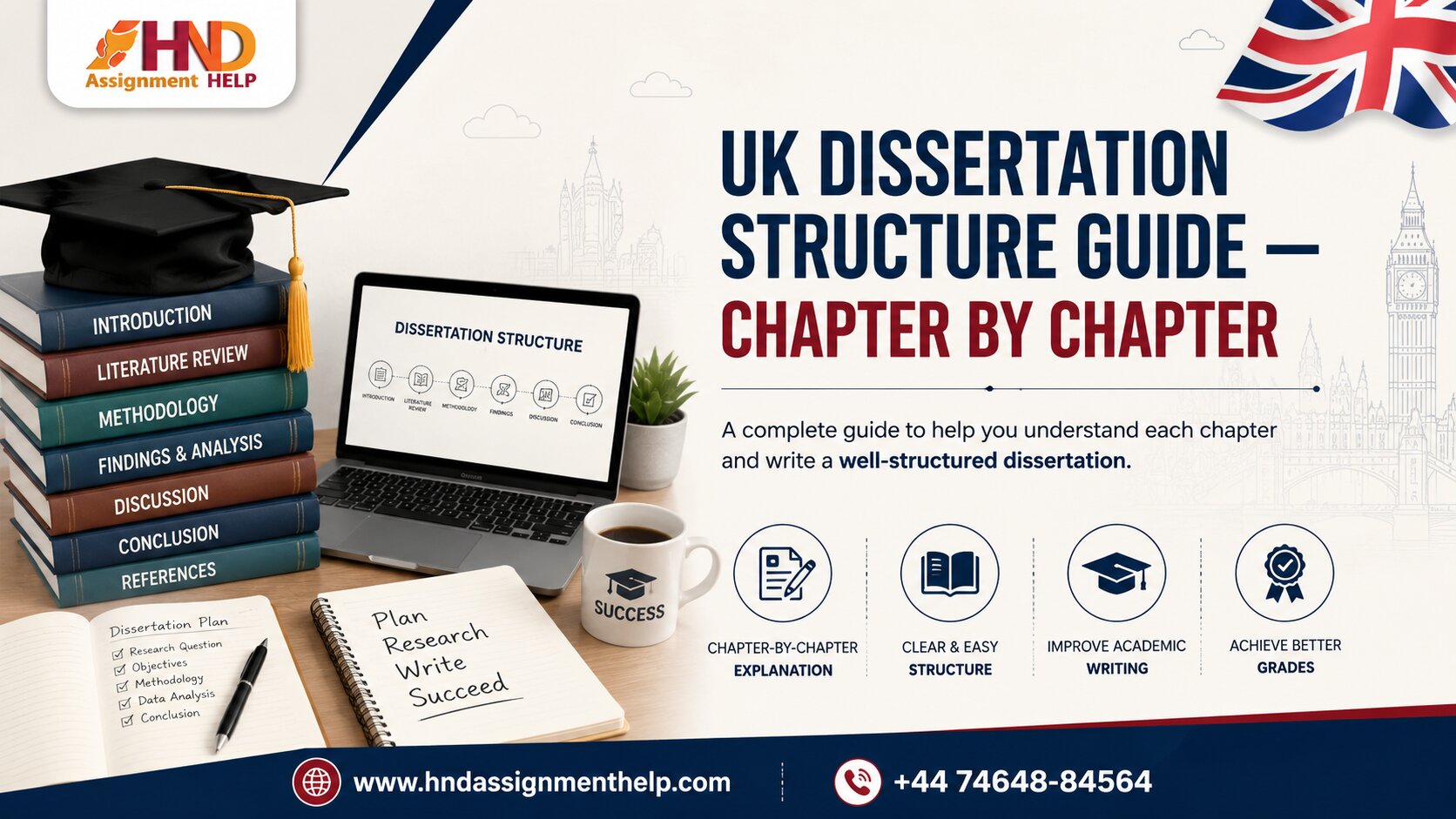
UK Dissertation Structure Guide — Chapter by Chapter
UK Dissertation Structure Guide — Chapter by Chapter
Writing a dissertation is one of the most significant academic milestones for students at UK universities. Whether you are studying at undergraduate or postgraduate level, understanding the correct UK dissertation structure is essential before you type a single word. A poorly structured dissertation — no matter how brilliant the research — can cost you valuable marks.
This chapter-by-chapter guide breaks down every section of a standard UK university dissertation, so you know exactly what goes where and why it matters.
Why Dissertation Structure Matters in UK Universities
UK universities follow a rigorous academic framework. Markers assess not just the quality of your arguments but also how logically your work is organised. A clear dissertation structure demonstrates critical thinking, academic maturity, and respect for scholarly conventions. Most UK institutions — including Russell Group universities and post-92 universities — expect the same core chapters, though word count distribution and specific requirements may vary by department. Always check your university's dissertation handbook alongside this guide.
The Standard UK Dissertation Structure
1. Title Page
The title page is the first thing your marker sees, so it must be professionally formatted. It should include:
The full title of your dissertation
Your full name and student ID
Your degree programme and university name
The academic year and submission date
Your supervisor's name (if required)
Keep the title clear, concise, and reflective of your research focus. Avoid vague titles — a strong title signals confidence in your topic.
2. Abstract
The abstract is a concise summary of your entire dissertation, typically 150–300 words. It is one of the most important sections because it is often the first (and sometimes only) part read by external examiners.
Your abstract should cover:
The research problem or question
The methodology used
Key findings
The main conclusion
Write the abstract last, even though it appears first. This ensures it accurately reflects your completed work rather than your initial intentions.
3. Acknowledgements (Optional)
This short section allows you to thank your supervisor, peers, family, or anyone who supported your research. It is optional but commonly included in UK dissertations. Keep it brief — one paragraph is usually sufficient.
4. Table of Contents
A well-formatted table of contents helps your reader navigate your dissertation with ease. Include all chapter headings, subheadings, and their corresponding page numbers. Most UK students use Microsoft Word's automatic table of contents feature to ensure accuracy.
5. List of Figures and Tables (If Applicable)
If your dissertation includes charts, graphs, images, or data tables, include a separate list immediately after the table of contents. Number each figure and table sequentially and include its title and page number.
6. Introduction
The introduction is where you set the scene for your entire research project. A strong introduction should:
Introduce the topic and provide background context
Clearly state your research question or aim
Highlight the significance of the study
Outline the dissertation's structure (a brief "roadmap")
In UK dissertations, the introduction typically accounts for 8–10% of the total word count. Avoid the common mistake of writing an introduction that is too broad — ground your reader in your specific research focus from the outset.
7. Literature Review
The literature review is one of the most critical chapters in any UK dissertation. It demonstrates your understanding of existing research and shows how your study contributes to the academic conversation.
An effective literature review should:
Critically evaluate relevant academic sources (not just summarise them)
Identify gaps, contradictions, or debates in existing research
Justify the need for your own research
Follow a thematic or chronological structure
Use credible sources — peer-reviewed journal articles, academic books, and reputable reports. UK universities typically expect you to use sources published within the last 10 years, unless referencing seminal works. This chapter usually accounts for 20–25% of your word count.
8. Methodology
The methodology chapter explains how you conducted your research. UK markers pay close attention to this section because it determines whether your findings are credible and replicable.
Cover the following areas:
Research philosophy (positivism, interpretivism, pragmatism)
Research approach (deductive or inductive)
Research design (qualitative, quantitative, or mixed methods)
Data collection methods (surveys, interviews, secondary data, etc.)
Sampling strategy
Ethical considerations
Limitations of the methodology
Be transparent and justify every choice you make. Avoid simply describing what you did — explain why you chose that approach over alternatives.
9. Findings / Results
This chapter presents your raw data and research findings without interpretation. How you present your findings depends on your methodology:
Quantitative research: use tables, graphs, and statistical analysis
Qualitative research: use themes, quotes, and coded categories
Be objective and systematic. Organise this chapter clearly so the reader can easily follow your data before you begin to analyse it.
10. Discussion
The discussion is where your intellectual voice shines. Here, you interpret your findings, connect them to the literature reviewed earlier, and begin to answer your research question.
Your discussion should:
Explain what your findings mean in context
Compare and contrast your results with existing studies
Acknowledge unexpected outcomes or anomalies
Address the limitations of your own research
This chapter is often the most challenging to write but also the most rewarding. Strong dissertation writing at this stage separates a 2:1 from a First.
11. Conclusion
The conclusion brings your dissertation to a satisfying close. It should:
Summarise the key findings and arguments
Directly answer your original research question
Reflect on the implications of your research
Suggest avenues for future research
Acknowledge any limitations not covered elsewhere
Avoid introducing new information in the conclusion. It should feel like a natural, confident end to your academic journey.
12. Reference List / Bibliography
UK universities have strict referencing requirements. Common referencing styles include Harvard, APA, OSCOLA (for law), and Vancouver (for health sciences). Ensure every in-text citation has a corresponding entry in your reference list and that all entries follow your institution's preferred format precisely. Inconsistent referencing is one of the most common reasons UK students lose marks.
13. Appendices (If Applicable)
Appendices contain supplementary material that supports your research but is too detailed for the main body — such as interview transcripts, survey questionnaires, raw data sets, or consent forms. Each appendix should be labelled (Appendix A, Appendix B, etc.) and referenced within the text.
Final Tips for a High-Scoring UK Dissertation
Start early — most UK dissertations are 10,000–15,000 words at undergraduate level and 15,000–20,000 at postgraduate level
Follow your department's guidelines — always cross-check with your university's specific requirements
Use academic language — avoid informal phrasing and first-person narration unless your methodology requires it
Proofread thoroughly — spelling, grammar, and formatting errors damage your academic credibility
Seek feedback — use your supervisor's office hours and consider professional dissertation help if you feel stuck
Need Expert Dissertation Help in the UK?
Understanding the structure is the first step — but executing it to a high academic standard is a different challenge entirely. At HND Assignment Help, we support UK students with expert dissertation guidance, chapter reviews, and full writing assistance across all subject areas. Whether you need help structuring your literature review or polishing your final conclusion, our academic specialists are here to help you succeed.
Get in touch today and take the stress out of your dissertation.